

We're the Last Humans
This is a Chance

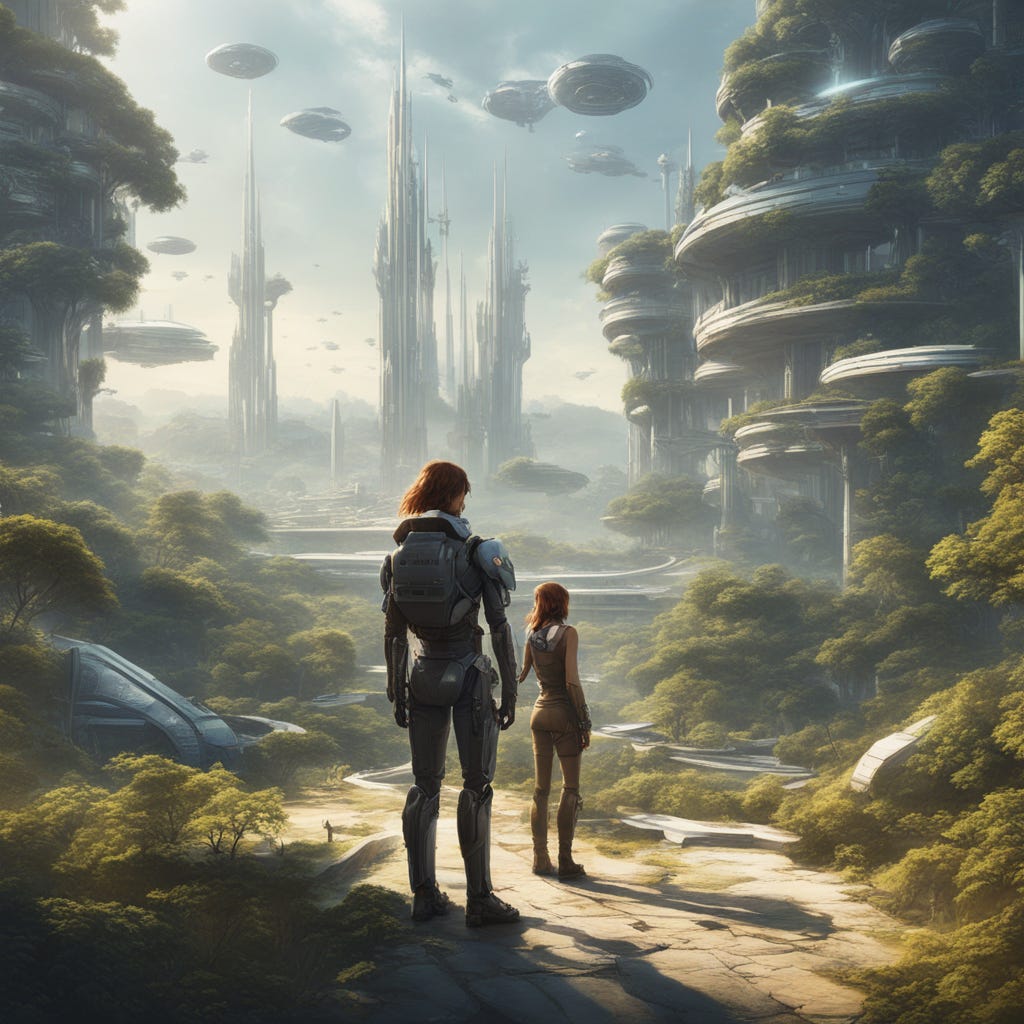
Artificial uterus, human robot, chips in the brain, organ replacement, ultra-controlled world, curing death, parallel virtual reality…
Sounds crazy and far away, but it’s the near future that some imagine for us.
Recently, I’ve been consuming a lot of content about the future. Interesting debates between philosophers, scientists, technocrats. It was instructive … and frightening.
With a bit of luck, I’m already old enough to escape this dystopia. But I can’t help thinking of the thirty-something I am, having experienced so many technological innovations. Those born up to 1995 are incredibly lucky: they’re the last global generation to have experienced a more or less normal world. Where technology was a tool, not a necessity.
Cell phones for the masses appeared in my childhood. Then, in my teens, the democratization of the Internet. Since then, it’s been a frantic race for technology to take an ever-greater place in our lives. Today, phones are extensions of the hand. Digital identities are extensions of personality. The boundaries between the real and virtual worlds no longer exist.
If you had told our generation, as children, that phones would be touch-sensitive, it would have been unthinkable, far away. Or that we’d be able to strap on a VR headset and roam a fake world. Even less so. And yet, today, we’re on the cusp of the first mass-market AI.
We’re the first humans to experience so many technological revolutions in one lifetime. Our ancestors lived with one major technological evolution in their lifetime. A single paradigm shift.
And if we go back in history. Some didn’t experience any. Technological evolution was slow, taking place over hundreds of years. They had other challenges. But their way of life remained the same. From beginning to end.
This race to innovate may be one of the reasons why we feel that time is passing more quickly. We never have time to rest. There’s always something new. New information. We’re always alert.
We live in a world where technology has taken over. A world where the virtual is sometimes more important than the real. And for the generation that has known the world before, I have the feeling that it’s difficult to find one’s place in this world where borders are blurred. Stuck by the feeling of having known a life without all that. And the need to use technology for everyday actions.
But we’re not the only ones to suffer. Younger people, who have had screens since childhood. Feel a sense of unease. That this life is not our natural life. That living one’s life through social networks is not the way to live one’s life. Nor is being tied to a screen. That these virtual lives are synonymous with anguish.
Scroll through the themes of popular YouTube videos. Suffering is ubiquitous. It talks about dopamine detox. Aware that these feeds are creating a disorder. It talks about loneliness, an epidemic. A paradox in such a connected world. Social networks, instead of bringing us together. Allow us to live alone together.
Well, we’re not really “alone”. Because technology has ensured that something never leaves us: capitalism.
Thirty or so years ago, the only gateway to capital in your home was the television (or mail). But once you turned them off, they had no access to you. Today, capital is in your pocket. And worse, it knows everything about you.
From your interactions on social networks, it knows what you like, what you don’t like, what you consume, how much time you have to consume it. Your standard of living, your political thoughts, your interactions with friends and family. They know what you visit, how often, when, or…
That phone you love so much.
That you spend so much time on.
May be playing for the other side.
But all that is nothing compared to the future that’s just around the corner. Where everything will be monetized. Where, if we stay in this system, the gaps will only widen. Some will have everything, others will share what’s left: nothing.
The first stage of this great takeover will be the democratization of AI on a massive scale. When we live in a system where the goal is not human beings but profit. When humans accept this social contract where they are the losers of the deal. We shouldn’t be surprised when companies replace what can be replaced.
It’s already started. Layoffs are happening right now. The essence of our system is profit. Human beings, when they can be replaced, will be.
But it’s not just our jobs we’re about to lose. A war of competitiveness is about to begin. Humans are no strangers to competition, but they’re going to need weapons.
How can we fight against these over-trained AIs with our human brains? We’ll have to find a way to compete with the machine. Our Tony Stark will engineer a miracle cure: augmentation.
You’ll be offered a chip, a device, an invasive brain procedure to bring your abilities up to the level of an AI. A free procedure, since you’ll be the product.
Man 1.0, who until now has used tools to improve his work, will become the tool. After all, this is an expected end for those who have always accepted being a tool of the system, replaceable and interchangeable.
With this “upgrade”, you can now be quite competitive. Your brain connected to general intelligence can perform miracles. Communication will also be much faster.
This will bring two massive problems:
The impossibility of being competitive if you don’t get one. Few will have the choice in the face of economic constraints
The obsolescence of those who don’t get upgraded
The cognitive capacities of Homo Upgradus will be the equivalent of firearms, while those of Sapiens will be stone. Sapiens, Human 1.0 will be marginalized. Extinguish himself.
No matter how hard Human 1.0 tries to convince these new kind. “Be careful, it may be a mirage.” They’ll be ridiculed. Is this outdated man still intelligent enough to make even one judgment?
Homo upgradus will be intelligent. But free? Impossible. All this new intellectual power is a danger. Safeguards will be needed. Homo upgradus must become knowledgeable. To be free to produce, to consume, but certainly not to think. He’ll have to stay in line. These limitations will be sold to you as necessary. Security always comes at a price. Even freedom.
The artificial intelligence of Homo Upgradus will bring us its share of new technologies. Paradigm shifts will be legion. The mysteries of the universe will be unraveled. The limits of the visible and invisible world will be explored. The Upgradus will be able to tackle a challenge worthy of its stature: the quest for immortality.
Progress in health, replacement of defective organs, cure of all diseases, stabilization of the aging process… Upgradus will have to invent a new word. Because he won’t be immortal. There’s always a danger of dying by accident. Or by a source of failure or violence.
If we wanted to imagine the worst. The only flaw in Homo Upgradus is risk. You’d think his next goal would be to eliminate all risk. Upgradus could tackle emotions. A molecule would eradicate all violent feelings in humans. Anger, revenge, jealousy… We’ll have to accept the new rules: for everyone’s safety.
A controlled eternal existence, from beginning to end, to ensure survival. Humanity will thus become immortal in an existence without any depth, devoid of its essence.
At that point, we may well wonder whether Homo Upgradus is still human. Those tearing themselves apart over the results of Theseus’ ship thought experiment have some exciting verbal jousting ahead of them.
A philosophical paradox that explores the concept of identity. How can you say that something is always the same after a certain period of time?
We imagine Theseus on his boat, consisting of a sail, wooden planks and a mast.
The boat sets off on a long quest. At each port of call, parts have to be replaced. After replacing a wooden planks, it’s still the same boat.
But the journey continues.
The mast and sail are damaged. They are replaced by new ones.
After long years on the sea. All the boat’s wooden planks have been replaced.
All the original parts have been replaced.
Question:
Is it still the same initial boat?
If not? At what point did it lose its identity?
So, after being replaced, piece by piece, is the human still human ?
If the answer is no. Then yes, we are the last humans.
A fine reminder to ... look up.
Wow, that's a lot to unpack. You've touched on some of the most pressing ethical, philosophical, and existential questions of our time. The rapid pace of technological advancement is indeed a double-edged sword. On one hand, it promises to solve many of humanity's most pressing problems; on the other, it threatens to undermine the very essence of what makes us human.
The concept of Homo Upgradus you've described is a chilling one. It's not just about the loss of jobs or even the loss of our "natural" biological state. It's about the loss of our humanity, our ability to think freely, to feel deeply, and to make choices that are truly our own. The augmentation you talk about—chips in the brain, organ replacement, and so on—could indeed make us more efficient, more intelligent, even more "perfect" by some measures. But at what cost?
The question of identity you've raised, likened to the Ship of Theseus paradox, is a poignant one. If every part of us is replaced or augmented, are we still "us"? And if not, when do we lose our identity? Is it the first chip implanted in our brain, the first organ replaced, or some other milestone?
The younger generation, raised in a world where screens are the norm, are already grappling with a different kind of identity crisis. The lines between their online personas and their "real" selves are increasingly blurred. And as you've pointed out, the emotional toll is evident. The rise in loneliness, anxiety, and other mental health issues, even in a world more "connected" than ever, is a testament to that.
And let's not forget the omnipresent eye of capitalism, ever watchful, ever calculating. It's not just about selling us products anymore; it's about selling us lifestyles, identities, and even, as you've suggested, our future selves. The data collected is no longer just data; it's a blueprint of our lives, a roadmap to our souls.
So, are we the last humans? Perhaps. If the trajectory we're on continues unabated, we may very well be. But I'd like to think there's still time to change course, to question the path we're on, and to reclaim not just our identity but our humanity. After all, the future isn't written in stone; it's shaped by the choices we make here and now. And those choices are still ours to make. For now, at least.